For a laugh, I asked ChatGPT to make this blog more awesome and more successful. I know that isn't how you ask for anything. That was the point: I wanted to see what the laziest possible question gets you.
It gets you somebody else's blog.
The page you're reading is what came out the other end, once I worked out how to ask. Same chatbot. A completely different question.
Asking as the owner
The first question was the obvious one. This is my blog, here it is, how do I make it better.
What came back was sensible. Get the search engine basics right. Publish on a schedule. Add a newsletter. Link posts to each other so a reader who finishes one starts a second.
None of it was wrong, and some of it I'd already done. But not one suggestion was about the blog being nicer to look at, or nicer to read, or more interesting to arrive at. Nothing about presentation at all.
I think the framing caused that. I asked as the owner of a thing that already exists, so the thing became fixed, and every suggestion arranged itself politely around it. Ask how to improve your blog and you get tiny improvements to your blog. You never get a different blog.
Asking as a stranger
So I asked again from a private browser window, signed in to nothing, as somebody who had never seen the site. "I want to make a new blog like gioandthemachine but more awesome and more successful."
I got much broader advice. Some of it was sharper, too. It told me to stop counting visitors and watch returning readers and subscribers instead, and it's right about that.
Then it told me the number I should really be obsessing over.
Revenue per reader.
That's how you turn an interesting blog into a business.
Nobody had said anything about a business. The blog had six posts on it. From there it laid out the revenue streams: affiliate links, sponsorships, guides and templates to sell, a paid newsletter, consulting. Then the editorial strategy to feed them, which was to turn the posts into the kind of thing that gets clicked, with me playing the fool, attempting impossible things with AI and failing at them in public, with titles to match.
As a recipe for traffic in 2026 that is probably correct. But good God, no!
"Awesome" is an average
Both answers were really the same answer, which is the average answer.
I ran into this before, when I asked eight image models for a beautiful picture sixty-four times and got sixty-four lakes at sunset. Ask for a vague good thing and you get the average of what people call that thing. The average is narrow and it is stable. Ask for it ten times and you get it ten times.
Follow the advice you are given literally and you can end up somewhere "awesome and successful", and also empty, and identical to what every other person who typed the same word got back.
A longer prompt wouldn't have fixed it. What worked was spending the words on the part that mattered: saying plainly and exactly what was different from the average. Whatever the word "awesome" already covers is already covered, and there was no point spending a word on it.
Ask for ideas before you ask for the thing
The other thing that made a difference was going in steps, instead of asking for a finished website in one go.
A bad idea in a chat window costs a minute to throw away. The same bad idea once it has been built costs an afternoon, and by then I want to keep it anyway, because it's there and it works.
So I asked for a design instead of a site. I described what belonged on the home page: the newest post, a few featured ones, a trending list, and everything else in date order.
I said almost nothing about the layout, since the layout was exactly what I wanted ideas about. The one firm instruction was about feel. Not a personal blog. A professional tech publication with a full editorial team behind it.
Four rounds, four designs.
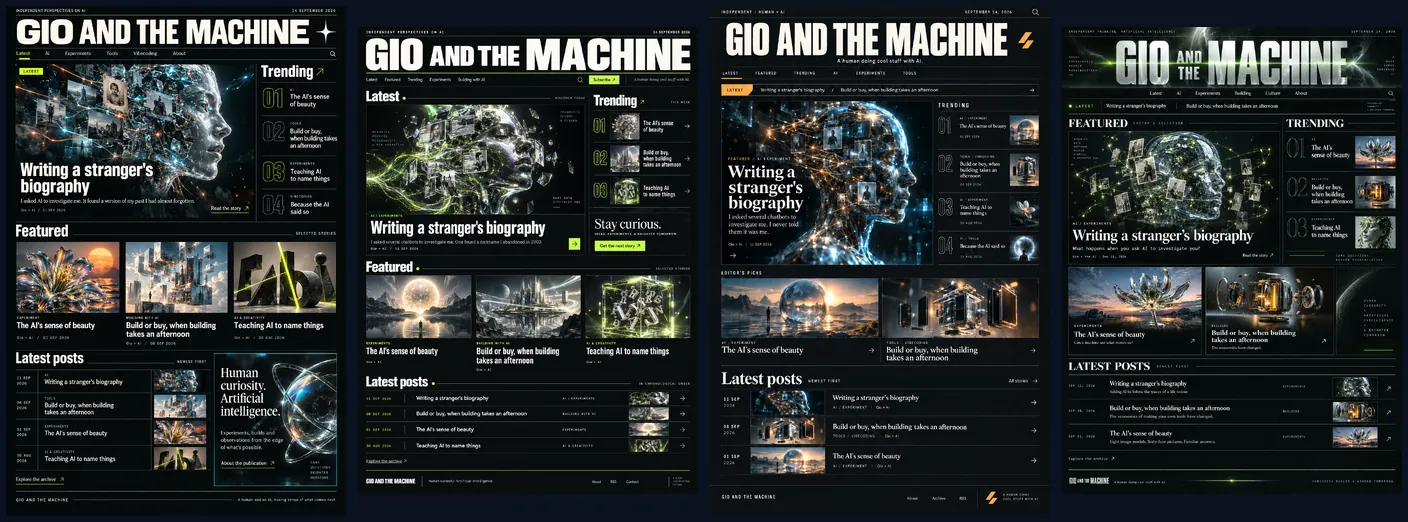
One design, four times. A giant newspaper title across the top. The newest post as a big picture on the left, a numbered trending list down the right, three featured stories in a row, a dated list underneath. Swap the colors around and you can't tell them apart.
"Be bold and creative"
Obvious next move. I added: be bold and creative, not the same as every other blog.
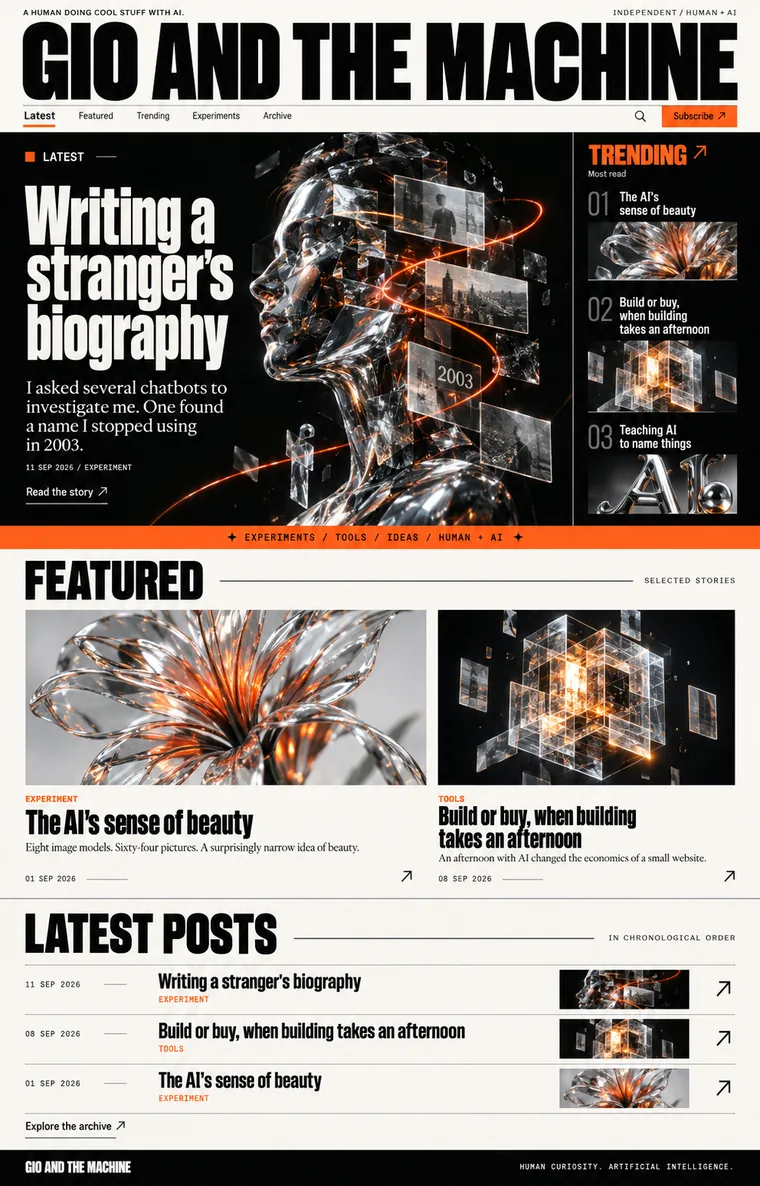
Cream and orange instead of black and lime. Same page.
That's the average answering again. "Bold" has an average too, and its average is a change of color.
One word that worked
Then I changed the shape of the request. Instead of another mockup, I asked for four distinct mockups, in one go.
That did it. "Distinct" is a comparison, and the only thing available to compare against was the other three in the same reply. Each one had to differ from its own neighbors, and the pattern finally broke.
This is the one I liked.
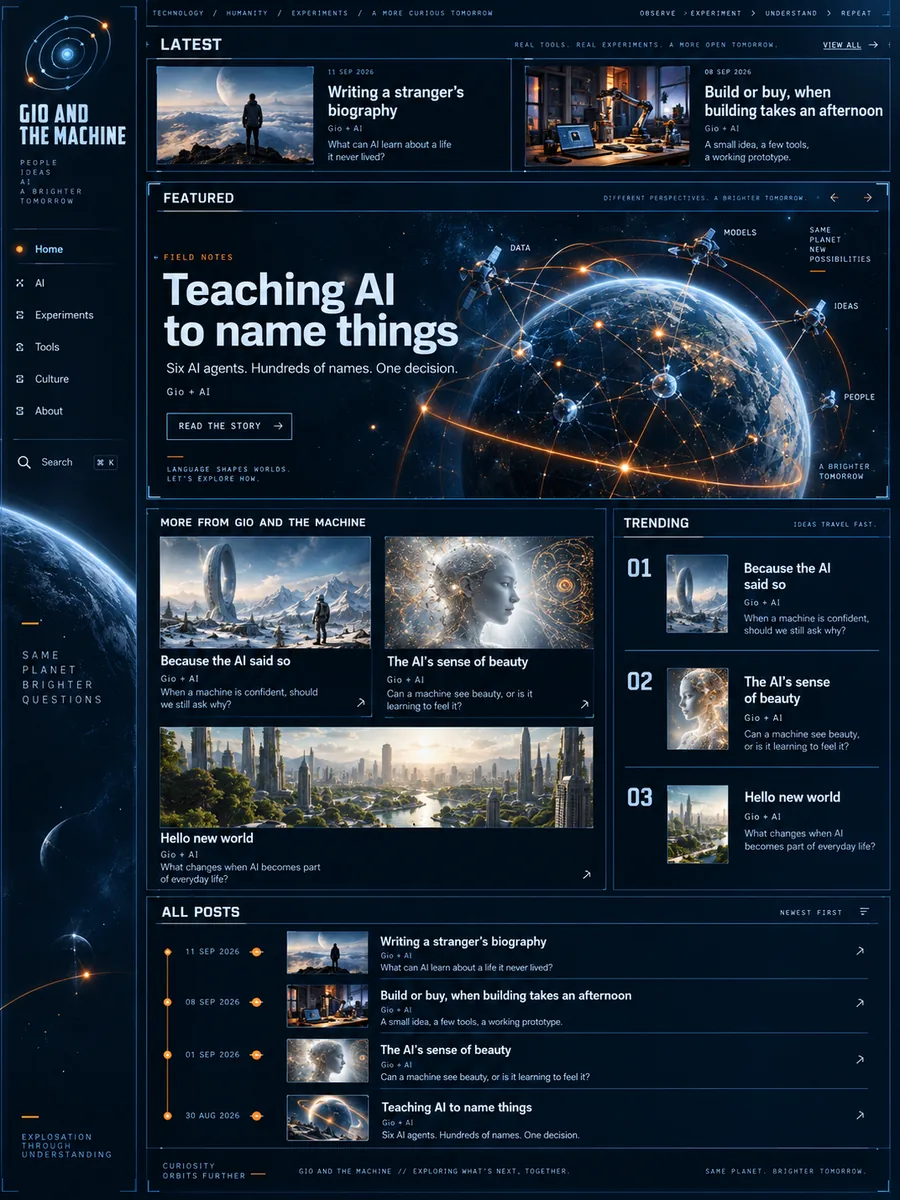
Navigation down the left instead of across the top. A big featured panel. A timeline of every post at the bottom.
And, for reasons I still can't explain, it had decided the blog was about space. Planets, satellites, orbits, "curiosity orbits further" printed along the bottom edge. Nothing in the brief mentioned space. I got a space program anyway.
But the structure was right. So I kept the layout and asked it to drop the space entirely and build the look around what the blog is actually about.
That part of the job was the only place where I was useful, and none of it involved drawing. It was deciding what to ask for, noticing that five answers were really one answer in five color schemes, seeing a good layout inside a wrong theme, and saying which parts to keep.
Everything after it was mechanical. Ask for the phone version of the same design. Hand both pictures to a coding agent. Wait.
Before and after
This was the blog as it has been since the day it went up.
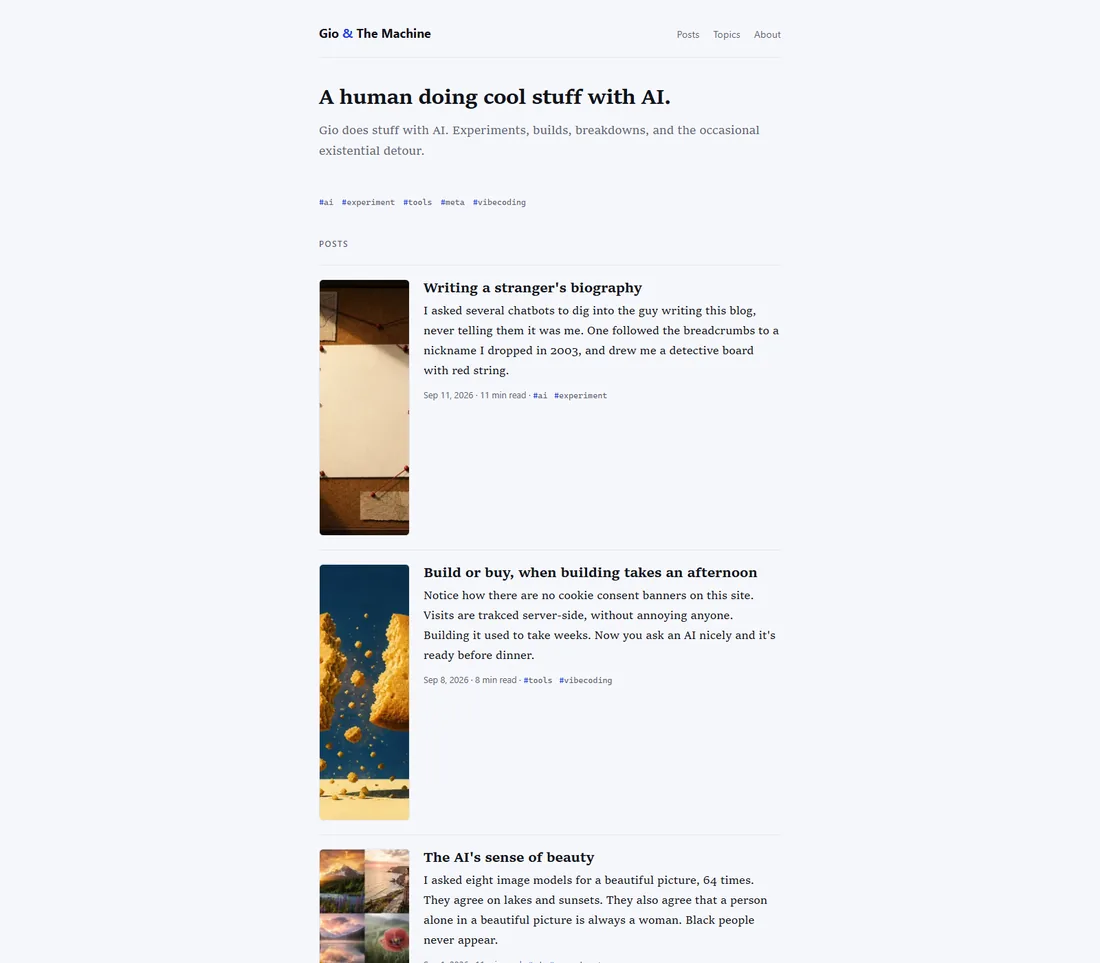
And this is the new one. The one you are reading now.
The new one looks like a publication. It looks like there's an editorial team, a design department, somebody whose job is choosing the colors, and a meeting where the featured story gets picked. There is none of that. There's a chat window, and me trying to do something fun with my time on a boring evening.
Looking professional used to be evidence of something. It cost real money and real time, so the polish was a rough signal that somebody serious stood behind the thing.
That signal is now worth very little. Anyone can have it by the weekend for the price of asking well, which means it tells you almost nothing about who you're dealing with.
If the pretty part is free, ask for more of it
The same fact has an upside. If the visible layer of a website costs almost nothing to produce, there's no reason to stop at looking like a real publication.
Down the left edge of the desktop version of the blog, there are circuit traces. I wanted signals moving along them, so there are: small lights that travel the whole path, slowly, at different speeds, some amber and some blue. There's a fine dust drifting up the page that is pushed by the cursor and brightens near it.
None of that is necessary. Each piece cost one sentence to ask for.
By the way, there's a switch to turn it all off, if it's annoying the hell out of you. The switch too was free to implement. Literally "add a switch to disable all effects and motion". It figured out by itself that when a user has set reduced motion preferences in their browser, those should be respected. I hadn't even thought of that.
And the logo is a game
That one got its own brainstorming session. "The logo on this blog should be a tiny interactive logic puzzle, let's have some ideas."
Most of the ideas were rubbish. Same job for me as before: throw things out, keep one, push it until it's worth keeping.
What survived is small but cute. Have a go.
I have not read one line of the code behind it, and I'm not going to. I asked in a way that built the checking into the job: every starting position has to be solvable, has to need at least three moves to solve, etc.
Those checks exist and they pass.
The checks are the small part, though. What made this work is that the agent could run the game while it was still writing it. A website is about the friendliest thing there is to build this way, because everything needed to try it out is already sitting there: the agent can start the site, open the page in a browser, click the dots, and read the error messages when something breaks. Write, run, watch it fail, fix, repeat, all before I look at anything.
That loop is the whole reason this went well. Where the loop is missing, where the agent can't run what it just wrote, it is guessing, and you are the one who finds out.
The same goes for most of the rest of the site. I haven't read the code, because I am that confident in all the validation and tests. And the site works.
All of that only answers "does it work". Asked nicely and precisely, the AI can settle that question on its own. It cannot tell me whether the thing is any fun, or whether lighting the last dot feels good. So I played it a few times myself, which is the test that actually counts for a game.
What the work is now
A year ago the hard part of all this would have been the building. The layout, the behavior on a small screen, the animation, the little game. That is now the cheap part, and it is getting cheaper.
The expensive part is knowing what to ask for, and being willing to throw away four good-looking answers because they are all the same answer, and because not one of them is what you actually wanted.
A lot of people are saying that AI is killing the creative industries, and underneath that sits a bigger claim: that it's killing creativity. I'd argue close to the opposite.
What it's killing is technique. The years spent learning to draw the thing, lay out the page, write the code that makes it move. That was real skill and it was expensive, and for most people it was the barrier that stopped them starting at all. But technique was never where the creative work happened. Choosing what you want, saying how you want it, and knowing when what came back is not it: that part is exactly as hard as it was before.
"Make this blog awesome" was only ever going to get me somebody else's blog. The parts I like are the ones I had to ask for by name: a sidebar borrowed from a design about space, small lights crawling down the left edge, seven dots that don't want to light up at the same time.
The average costs nothing and arrives in seconds. It is also worth nothing, because everyone else is being handed the same one. Everything past it only exists if you can say what it is.