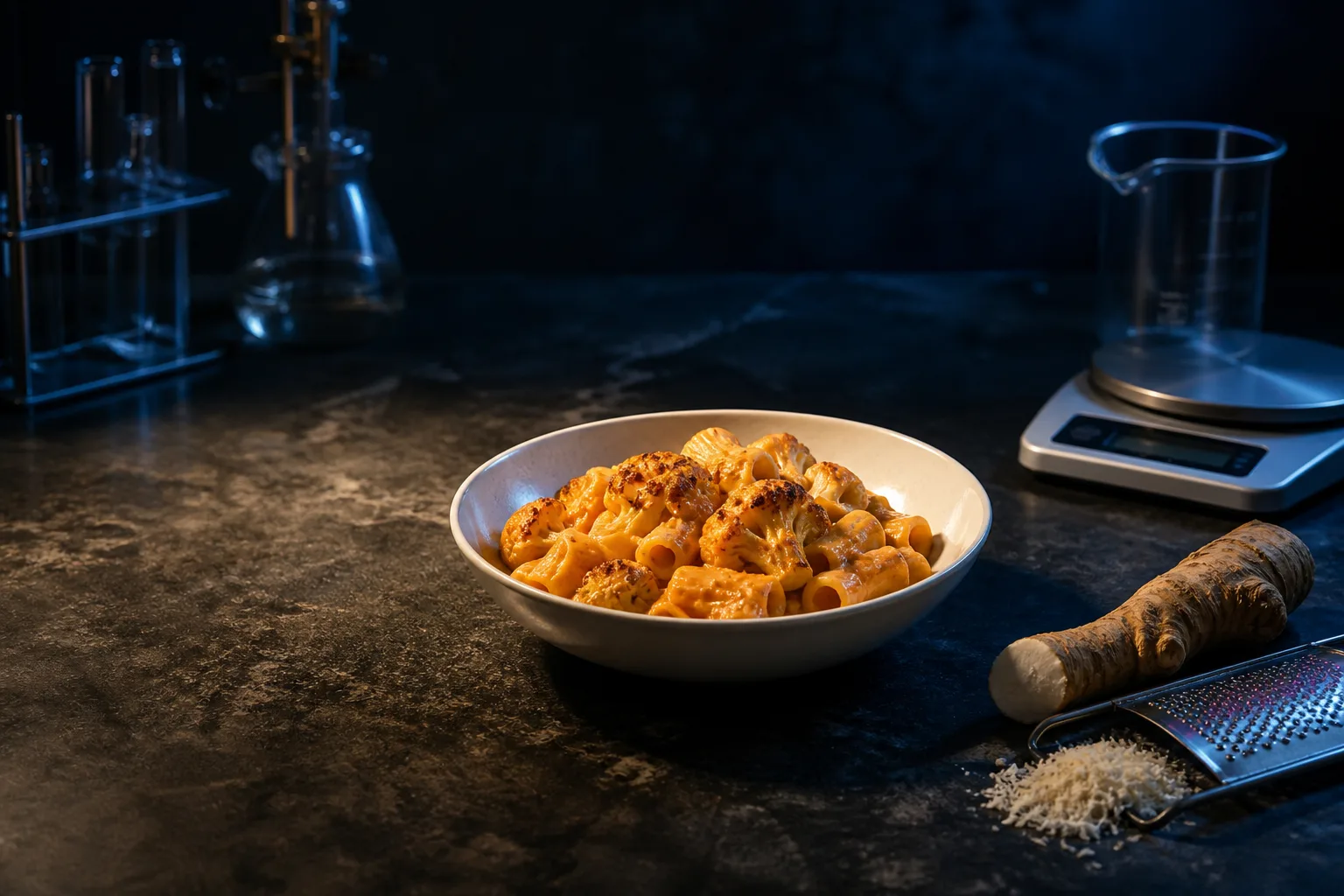
I had friends coming over for dinner, and I wanted to surprise them with something original. A dish nobody at the table had ever eaten, that still tasted good.
The sensible way to do that in 2026 is, of course, with an agentic pipeline. Apparently we'll soon be using agentic pipelines for everything, so why not start with tonight's meal.
So I built one. It produced a pasta sauce with cauliflower, mascarpone and horseradish in it, a combination that, as far as the AI could find, nobody had published before. Then real people ate it.
A kitchen full of agents
An agentic pipeline is several AI agents chained together, each with one specific job, passing the work down the line. I am entertained by the idea of applying these to all aspects of everyday life. I used the same approach to find a name for a project. This time the product was dinner.

It starts with a brief, and the brief is locked before anything gets invented. A warm pasta sauce for two people and 200 grams of dry pasta, made from ordinary groceries in an ordinary kitchen. It has to be a genuinely new combination of ingredients, with a good case that the people eating it will enjoy it. Locking the brief stops the agents from changing the rules later to suit an idea they happen to like.
Research agents then collect evidence: published recipes, comments from home cooks, and food science papers. They're strict about it. A comment only counts if the person actually cooked the dish, and cooked it more or less as written. "Looks delicious, can't wait to try it!" is not evidence. Neither is a glowing review from someone who swapped half the ingredients.
The food science is the most serious-looking part. There's a whole field of research that measures taste. Panels of trained tasters score foods on sweetness, bitterness, aroma and texture, and researchers turn those scores into taste maps, where foods that taste alike sit close together. Other studies ask ordinary people what they like, and often find that they split into groups with very different preferences. There are even databases listing the flavor molecules inside each ingredient.
The agents are careful with it, though. Two ingredients that share flavor molecules don't automatically taste good together. One well-known study found that Western recipes tend to combine ingredients that share molecules, while East Asian recipes tend to avoid doing so. So the chemistry is only used to suggest ideas.
The most useful science for the actual recipe was plainer: what cooking does to an ingredient. Heat weakens the sharpness of horseradish, for example, so the final recipe adds it at the very end, off the heat.
Next come the inventors. Several agents come up with ideas at the same time, each pointed in a different direction, one at vegetables and another at meat and fish. Ask two agents to simply "be creative" and they'll often have the same idea twice. In the first round, two inventors working separately both proposed fennel, peanuts and cheese. It works better to do the creative part first, one level up: list as many genuinely different directions as you can think of. Then give each inventor one direction as its own brief, and make it stick to that brief.
Every idea then goes through a novelty check, and this is where most of them die. Agents search the web for the combination in several languages, and not only in pasta: salads, soups, stews and old cookbooks too. It turns out that inventing food is hard. Humans have been cooking for a very long time, and they've tried most things. One idea was a medieval lentil recipe. Chicken with coffee and white beans already exists as well, which I still find hard to believe.
The survivors become full recipes, with exact quantities and a cooking order. Separate agents then review them: one for novelty, one for cooking problems, one for whether the target audience is likely to enjoy it. The reviewers read the plain recipe before they see the inventor's explanation of why it's brilliant. And the agent that picks the winner never invented or edited any of the candidates, so no agent gets to judge its own idea.
Last, a checker reads the winning recipe step by step, the way a cook would. Is every ingredient used somewhere? Is any water counted twice? Is the pasta ready ten minutes before the sauce? The pipeline's documentation has a whole table just to explain where each quantity of water goes.
A coordinator agent watches the whole thing, checks in every 30 minutes, and restarts anything that gets stuck.
First attempt: tahini, obviously
My first brief asked for a sauce with broad appeal across cuisines. Something that most people would like.
It took three rounds. The first round produced 21 ideas and no winner. The second produced nine, and according to the pipeline's own notes, every one of them used fruit. Pork and kiwi. Chicken with grapes, tahini and Parmesan. One agent proposed chicken, pineapple and mushroom pasta, which was rejected because someone had already published it. Good taste had nothing to do with it, at this stage.
Tahini kept coming back. Ten of the 36 ideas had it. The third round finally produced a winner: pasta with pork, fennel, chestnuts and... tahini!
I'm Italian. I read that recipe and felt disturbed in a strange, personal way. Tahini, on pasta.
The system had done exactly what I asked. I wanted a recipe most people would like, so it designed one for a generic, international pasta eater.
But I am not a generic, international pasta eater.
Italians are a special audience
Italians are a very specific group of pasta eaters, with their own special needs when it comes to their traditional food.
Most people around the world would happily put pineapple on a pizza, or chicken in their penne. Most Italians would take either one as a deep personal offense, possibly against their whole family. We have strict rules about which pasta shape goes with which sauce. We don't all agree on what the rules are, but we all know when you're breaking them.
This is also why Italians never eat pasta abroad. A restaurant in London or New York cooks its pasta for the average international customer: the same generic pasta eater my pipeline had been designing for. We know we'll be disappointed, so we order something else.
Round four, for Italians only
So I changed the audience. Not all of my guests were going to be Italian, but most of them were. So same pipeline, same novelty rules, but now the dish was for regular Italian pasta eaters.
That changed which evidence was selected. The research agents read Italian recipe sites. They found a survey where Italians list firmness, and pasta that holds on to its sauce, among the things they care about. They read a sensory study comparing Italian and Spanish tomato sauces. The coordinator agent running the pipeline even wrote itself a rule: it must not assume that every Italian rejects unfamiliar ingredients. That's more generous than I would have been.
Six ideas came out. Four died at the first novelty check. A fifth, peppers with borlotti beans, anchovies and saffron, passed the cooking review and then was recognized as a paella in disguise.
The survivor was mezze maniche (short, wide tubes of pasta) with browned cauliflower, tomato, mascarpone and horseradish.
It was a bold combination, but I read it and didn't immediately reject it. For an Italian reading an AI-generated pasta recipe, that is high praise. Cauliflower with tomato is a normal-ish thing to put on pasta in Italy, and mascarpone stirred into a tomato sauce is a known trick. The horseradish was the new part. The closest things the agents could find were a cauliflower salad with tomatoes and a horseradish cream, and a Bloody Mary dip. The novelty reviewer called it a narrow pass, which felt fair.
One correction came from me before any cooking happened. The first version asked for exactly 8 grams of jarred horseradish of a specific kind, 80% root, and the AI had found a product on the market that matched. I pointed out that you can just buy a horseradish root and grate it. In hindsight, I shouldn't have made that correction, or should have been more careful about the way I made it. I'll come back to this later.
The recipe
For two people, in about 35 to 45 minutes. You'll need a pasta pot, a wide frying pan with a lid, a knife, a fine grater and a kitchen scale.
- 200 g dry mezze maniche
- 170 g trimmed cauliflower, cut into florets about 1 cm across, with the tender stems diced small
- 120 g plain tomato passata
- 40 g plain mascarpone
- About 5 g peeled fresh horseradish root, plus a little more to taste
- 12 g extra-virgin olive oil
- 1 g salt for the sauce
- 60 ml plain water for the sauce, plus small splashes if needed
- 2 liters of water and 12 g salt for the pasta
The steps are all on the pipeline's recipe card below. The mascarpone and the horseradish go in last, off the heat.

The dinner
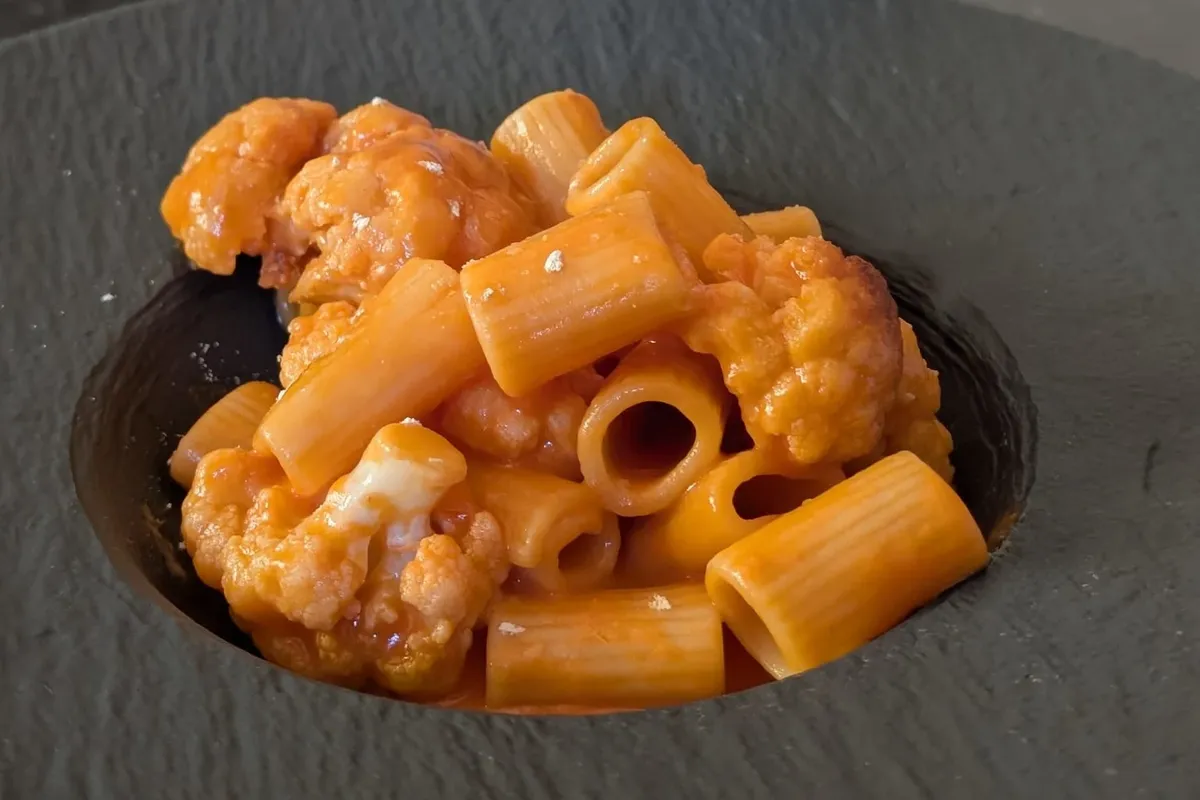
The first reactions were surprised, and not entirely enthusiastic. I suspect some people had come expecting my delicious traditional carbonara. They got something else entirely.
The real problem arrived before anyone tasted anything. I had optimized for taste, with some very serious science on top: sensory studies, consumer surveys, and in the latest version of the pipeline, a whole step for taste maps. I hadn't thought about smell at all. And smell is the first thing that hits you when the plate arrives.
The horseradish smell was, admittedly, too much. Putting horseradish in a pasta sauce and handing it to an Italian is a bold move already. One of the guests asked politely: "What did you put in it, horseradish or horse shit?"
In fairness, the pipeline had warned me. Its appeal review said that horseradish "can polarize". It had also promised "an integrated horseradish aroma", which turned out to be accurate. The aroma was integrated into the whole room.
Now, it's very possible I made it worse myself. Grating horseradish is what releases its sharpness, and in a jar, which is what the pipeline had suggested, a little vinegar keeps that under control. Thanks to my practical correction, our horseradish went into the pan freshly grated, with no vinegar, right before serving. My correction was never tested through the pipeline.
But once we got past the smell, the taste was actually pretty good. It felt like a genuinely new thing, made from ingredients you don't usually see together, and the combination worked. So, groundbreaking or literal slop? Somewhere in between, and a lot closer to the first than the smell suggested.
Humans in the loop
Anything you make with AI needs real-world testing, and humans in the loop. The pipeline did a lot of real work. Only 3 of its 42 ideas made it through. It also caught its own timing mistakes, like a pasta that would have been ready long before its sauce. But it never cooked a single dish, and everything it knew about taste came from what other people had written down.
The only test that counted was a table of people with forks.
If a thing is made for humans, humans have to be involved in deciding whether it's good, as part of an iterative process.
Peak pasta sauce
Overall, the meal was pretty decent. More importantly, it was a great conversation point at the table.
Doing this once for a laugh was fun. But my prediction is that soon quite a few restaurants will start doing something similar for real. That will be cool, in a way. I also expect it to cause some fatigue, and people will want to rediscover the joy of simple dishes, made by hand, by humans.
I think this goes well beyond food, to most crafts. The technical side is impressive, and the new tech opens up a world of possibilities nobody has explored yet. It can guide the discovery of new dishes, and of new things in general. New. Not necessarily better.
For a long time to come, the simple tomato sauce my grandma used to make will remain the best pasta sauce there is.